Searching in a market
that keeps shifting.
I started Boo while navigating my own next career move. The work was spread across job boards, company websites, alerts and application documents. Finding a role was only one part of it; I also needed to decide whether it deserved attention and how to present relevant experience.
I wanted to uncover opportunities that my usual search habits might miss, including roles on company career pages and signals that could lead me to a team worth approaching. That is the hypothesis behind Boo. It still needs to be tested in my own search.
I’m using the project to work through a product question with real constraints: where can automation save effort, where does AI add useful judgment, and where should the decision stay with me?
Prioritise sources
by their contribution.
I chose to start with sources that could produce useful, inspectable opportunities without expensive collection. More sources would also mean more duplicates, maintenance and noise. I wanted each addition to earn its place.
My criteria are relevance to the search, freshness, clarity of the original source and the effort required to keep a connector working. A structured role on a company board has a different job from a news item suggesting that a team might be growing.
Direct company boards
Start close to the original opportunity. Prioritise selected employers instead of collecting everything.
Greenhouse & Ashby connectors exist; company boards need configuration.A structured discovery feed
Get an initial stream into the product and test how filtering, source attribution and review fit together.
Himalayas is the initial feed integration. Source quality still needs validation.Deliberately forwarded alerts
Bring useful alerts into one review flow without making an entire inbox part of the product.
Planned: an optional, dedicated mailbox.Signals beyond job listings
Explore company and market signals as leads to investigate, with a clear path back to their source.
Exploration: not yet connected or validated.The sequence is a product choice, not a ranking of every possible job source. I’ll revise it as I learn which inputs lead to worthwhile opportunities.
Spend judgment
where it matters.
The first discovery prototype uses basic rules for search and senior-title filtering. I’m keeping collection and straightforward filtering separate from the planned AI work. Comparing a promising role with my experience or preparing a thoughtful application is a more specific reason to use a model.
The intended flow is to narrow the field first, then use AI selectively. The original source stays available, and I decide which opportunity to pursue and whether to send an application.
- CollectTraceable sources
- FilterSimple rules first
- AssessSelective AI support
- PrepareVerified experience
- DecideHuman review
Collection and basic filtering are in the initial prototype. AI assessment, Career Memory and application preparation are planned.
The budget belongs
in the user’s hands.
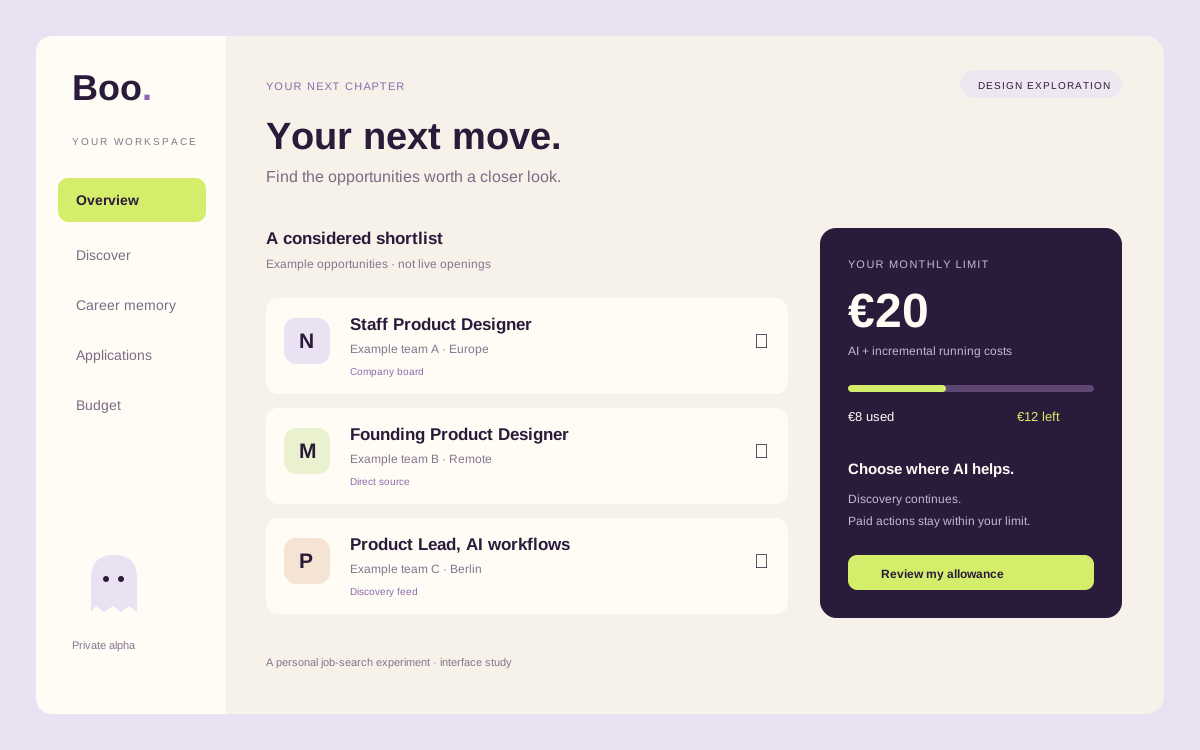
I set a ceiling of €20 a month for the whole experiment’s incremental AI and infrastructure costs. That made cost part of the product direction. I want the user to see what remains, choose where to spend it and understand what the system will pause.
For my €20 limit, the intended guardrails are a warning at €15, a pause on paid background work at €18 and a block on paid actions at €20. A useful free discovery flow should remain available when the paid allowance is gone.
Choose the allowance.
See what changes.
Illustrative values. This explores the planned controls; it does not run searches or AI.
AI + incremental running costs. My experiment stays at or below €20.
Room to prioritise
Use paid AI selectively for the opportunities worth a closer look.
- Public-source discovery & basic filtersContinues
- Scheduled paid AI workWithin allowance
- On-demand paid AI actionsWithin allowance
Illustrative guardrails: warn at €15 · pause paid background work at €18 · block paid actions at €20.
This is the intended interaction model. Production enforcement, cost estimation and provider accounting are implementation work still ahead.
A working start.
An open experiment.
In the initial alpha
- A responsive overview using explicitly labelled demo listings.
- An initial discovery feed, with links to original postings.
- Basic search and senior-title filtering.
- Temporary saved roles and prepared company-board connectors.
Still being built and tested
- Reliable source coverage, location eligibility and lasting job history.
- Career Memory grounded in verified experience.
- Explainable AI assessment, document preparation and enforced budgets.
- Whether the tool improves the quality and efficiency of my own search.
I don’t have outcome numbers to report yet. I’m looking for evidence that Boo surfaces opportunities I would otherwise miss, reduces repeated work and helps me make better decisions within the budget. The next iterations will come from using it.