A daughter, a language, and a reason to keep learning.
My daughter speaks Hebrew. Learning to read it was a different story. I designed and built an adventure that gave her a reason to practise, then opened it to other families facing the same gap.
A Hebrew literacy adventure built around discovery, movement and short moments of focused practice.
01 · Start with one child
Hebrew was already hers. The letters weren’t.
Naomi is ten. We live in Berlin, speak Hebrew at home, and her school life happens in German. She could express herself in Hebrew, but reading and writing it meant starting again as a beginner.
I started with a personal question: could I make practice something she wanted to return to? The opportunity was specific: children who already understand the language, but need a bridge into its written form. Their literacy level can be far below their age and spoken vocabulary.
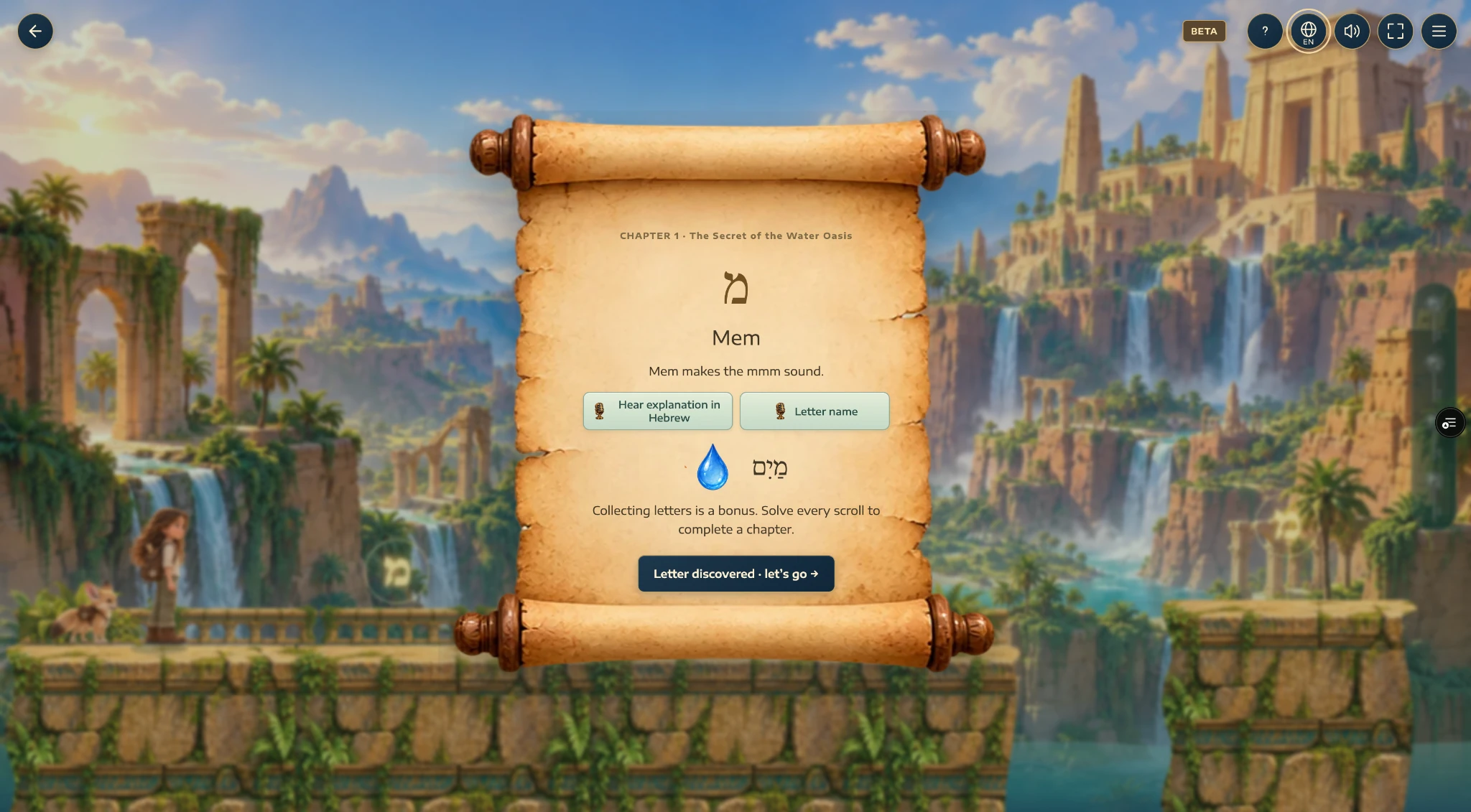
That shaped the world. An explorer and a fox companion, hidden scrolls, caves and gates gave the experience an identity beyond a lesson. I owned the product direction, learning sequence, interaction design, artwork direction, implementation and release, using AI tools throughout the build.
02 · The central design tension
Excitement brings them in. Learning needs room.
A platformer creates momentum: jump, collect, avoid an obstacle, reach the next gate. Letter recognition and handwriting ask for a different kind of attention. I treated that tension as a pacing problem. The design needed both the anticipation of the adventure and protected moments to listen, look and think.
Explore
Build anticipation
Movement, collectibles and new places make reaching the next scroll feel purposeful.
Discover & practise
Change the pace
Opening a scroll shifts attention to a short learning task. Music pauses during dialogs; audio and visual prompts become the focus.
Continue
Make progress tangible
A completed scroll contributes to opening the gate. Checkpoints and saved learning progress make returning easier.
The most important boundary: wrong learning answers never cost hearts. Platforming hazards can interrupt a run; uncertainty about a letter should invite another attempt. Losing a jump also preserves collected letters and solved scrolls. That keeps motor skill from erasing learning progress.
A deliberate shift in attentionThe adventure leads into a focused scroll. Short prompts, large audio controls and a single task reduce competing demands.
03 · A lens on motivation
Give practice a purpose inside the world.
The learning loop connects a letter’s sound, visual form and use in familiar words, then introduces writing and review. A child encounters the same letter in different ways. The gate gives those small tasks a shared destination.
Self-determination theory offers a useful lens on this design: a sense of competence, agency and connection can support motivation.1 Here, that lens helps explain the value of visible progress, room to explore and a character a child wants to inhabit. It is a way to examine my decisions, not a claim that the game has validated those mechanisms.
Game-based learning research also makes an important distinction: an engaging game does not automatically produce learning.2 My working hypothesis is that alternating adventure with focused practice can sustain interest while preserving attention for the learning itself. I have not measured adrenaline or cognitive load; I can observe where children hesitate, retry, ask for help and return.
04 · Feedback that changed the product
He didn’t want to play as a girl.
The first heroine grew out of a game made for Naomi. During the beta, a boy said he did not want to play as a girl. That revealed a limit in a product built around one child’s preferences: someone else could enjoy the idea and still not see himself in it.
I invited him to become the inspiration for a boy character. His feedback became a way to participate in shaping the world, and character choice became part of the product.
I treated it as a specific barrier to entry, rather than evidence that all children want the same thing. The decision expanded choice while preserving the adventure and learning sequence. Whether character choice changes first-play conversion or return behaviour remains a question to investigate.
From one child’s world to a shared oneA boy’s reluctance to use the original heroine led to an invitation to inspire a new character.
05 · Build quickly, make deliberate trade-offs
About three weeks from concept to beta.
AI-assisted development shortened the distance between a design decision and a playable version. I used it to help implement interactions, produce and refine illustrated assets, and iterate on learning content. My responsibility was to define the experience, check the output and decide what was good enough to put in front of children.
Reach before rendering ambition
Switch from 3D to Canvas 2D
The early prototype used React Three Fiber and Three.js. WebGL availability became a constraint. Moving the active game to Canvas 2D preserved the illustrated world and platforming while removing the WebGL requirement. The technical choice served access to the experience.
Confidence before precision
Make handwriting guided practice
Tracing checks shape coverage, precision and stroke length. It does not claim to recognise handwriting or assess stroke order. This made a useful practice interaction feasible without promising a capability the system could not reliably provide.
Test the family context
Separate the parent’s job from the child’s
Parents manage access and the subscription; children have their own player profiles and progress. A family account supports up to three players. That reflects how the product is bought and shared at home.
The beta was a learning milestone. Payments, family access, onboarding, language support and device refinements continued afterwards. Separating those stages made it possible to test the core experience early and build out the service around it.
06 · Make the next decision measurable
A visit is a beginning. What happens next?
As the audience grew beyond my own family, the product question changed. Could other children get into the game, progress through it and choose to return? I added behaviour instrumentation around the journey so iteration could draw on both direct feedback and observed use.
Questions the instrumentation is designed to investigate
Product question
Signals
Decision it can inform
Can families get started?
Authentication steps, player creation, play start
Where onboarding needs simplifying
Where does progress become difficult?
Level and scroll progress, answer attempts, help requests
Whether an explanation, task or interaction needs attention
Does interest survive the first visit?
Return visits and active play
Whether to prioritise early friction or more content
Where does the trial lose parents?
Paywall views and checkout steps
Whether access, value or purchase flow needs clarification
These are signals to interpret, not interchangeable success metrics. Repeated events are not unique children, active play is not proof of learning, and a checkout click is not a subscriber. Actual payments come from Stripe records.
Measurement is gated by adult consent, with owner-browser and preview exclusions. Events omit names, emails and children’s answers. That limits coverage, but lets me learn about the flow without putting personal learning content into analytics.
07 · Early demand, careful expansion
The personal problem wasn’t only ours.
Sharing the game brought more families into the beta and requests from additional communities. Those requests opened two different opportunities: helping Hebrew-speaking children through more interface languages, and considering whether the approach could eventually serve other heritage languages.
Those are different product bets. Translating instructions preserves the Hebrew learning goal. Teaching another language requires new content, sound explanations and validation. I would test that separately before treating the game as a general language-learning platform.
The current offer is a family subscription at €8.90 per month. That creates a product obligation: families need a useful reason to continue. The next direction explores reading and words through new adventures; returning use and learning needs should guide that investment.
Early evidence, November 2026: Naomi’s progress, feedback from beta families and requests from other communities. These are promising signals. Retention, conversion and learning outcomes across a broader group are still being evaluated.
08 · What I would do differently
Keep the closeness. Widen the evidence.
Starting with my daughter gave me immediate access to the problem and a fast feedback loop. It also made it easy to design around her preferences. The boy’s feedback made that limitation concrete.
Next time I would bring a small, varied group of families into the first playable version, introduce behaviour measurement earlier, and pair it with simple checks outside the game. I want to understand both whether children return and whether they can recognise or use what they learned in another context.
The strongest outcome so far is that a personal need became a working service: a learning experience, a technical system, family access, a business model and a way to learn what to build next.